

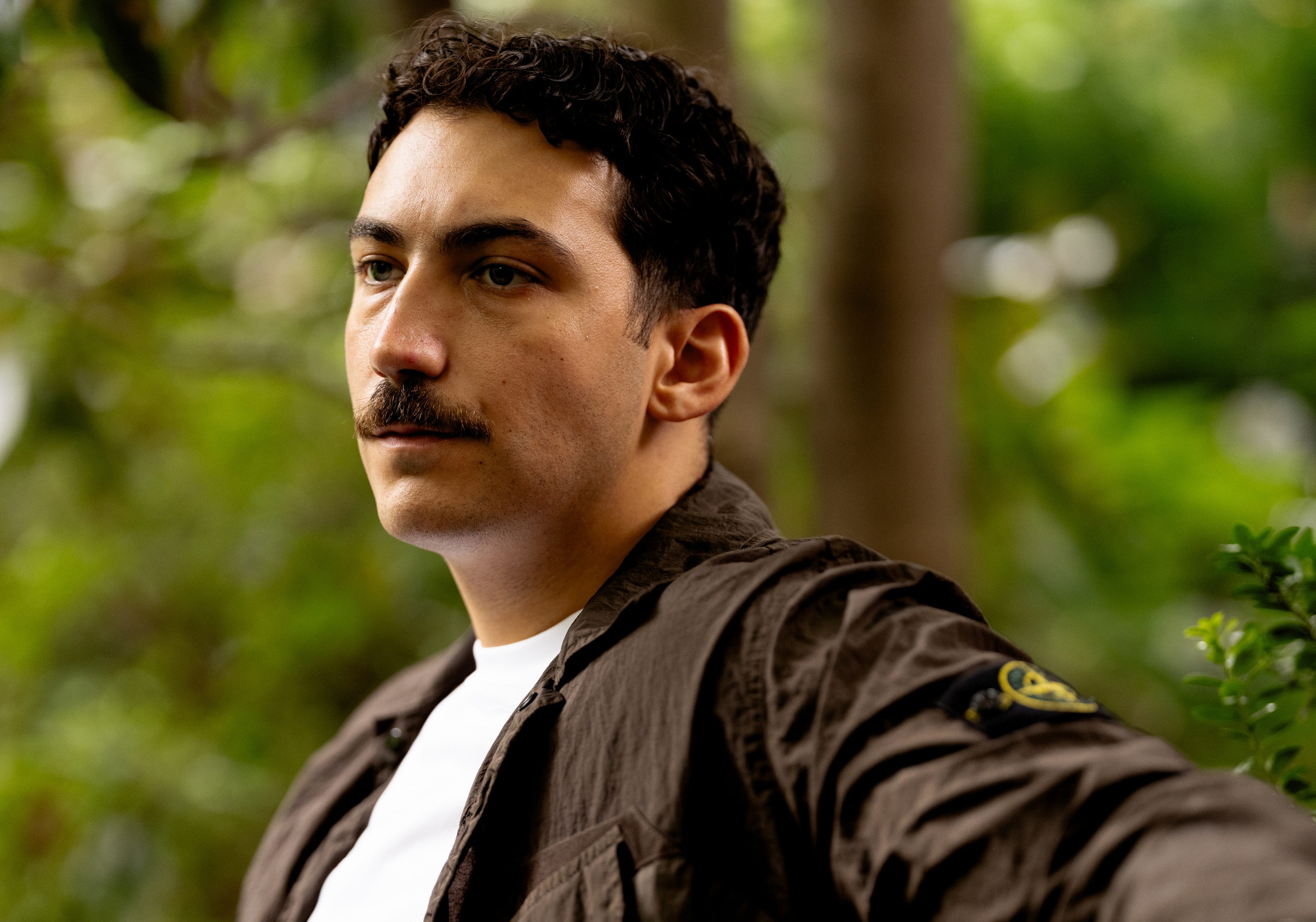
In modern hip-hop, producers have become the conductors of the culture, bringing artists together around a shared vision. For previous generations, it was Pete Rock, J Dilla, Madlib, The Alchemist, and Statik Selektah. For today’s new wave of thought-provoking hip-hop, it’s Stoic, the Grammy-winning producer behind songs for Doechii, MAVI, Lexa Gates, and more, who is bringing the new generation together on his debut album, “PAELLA!”
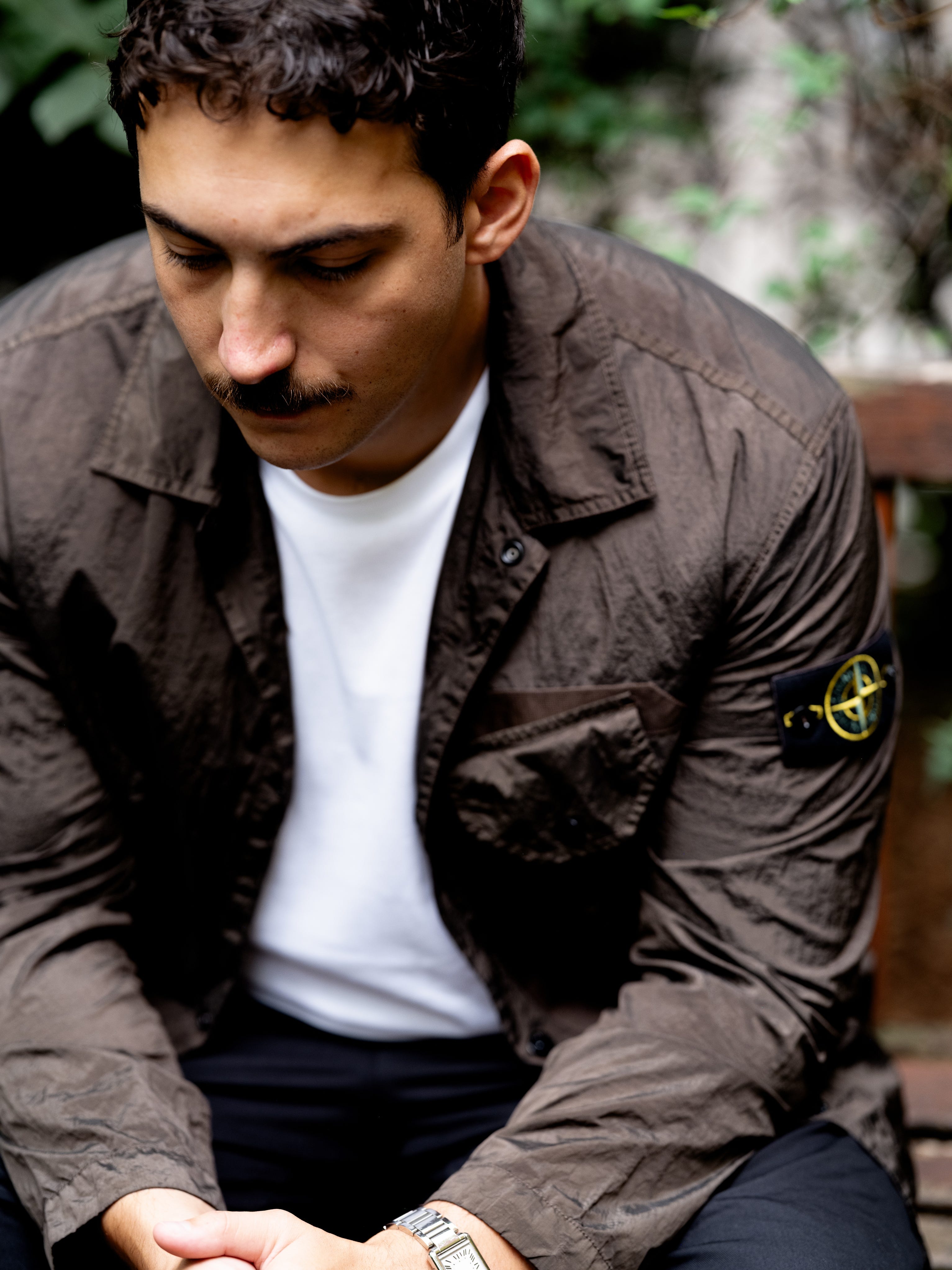
A New York native raised in a musical family, Stoic met us in the West Village to talk about his sample-based sound, the new generation of rappers, the current state of hip-hop, building a sustainable career as an underground producer, and the challenge of juggling different roles while putting together an album featuring more than 10 artists.
Before we dive into the album and your career, I’d like to start with your upbringing since it’s not a lot of information online. How did your childhood shape your path into music?
Yeah, I think that’s the most obvious cliché that everyone likes to say: “Oh, I grew up with my parents’ music.” But fortunately, that was the case.
I grew up listening to a lot of classic rock. My first concert was Rush when I was 8 years old, and I looked around the concert and didn’t see a lot of other 8-year-olds. So I always thought that was cool.
It was a lot of classic rock, and then slowly but surely it progressed into hip-hop when I was a teenager. The first thing I listened to was Lil Wayne. He was huge and all over the radio. He had that mainstream appeal, but he also had deep cuts. I felt like he was my foray into really good rap music.
At that time, Eminem was doing his thing. Kanye, obviously. JAY-Z, 50 Cent. Guys like that who I would hear on the radio, and then I would discover, “Oh shit, they have more music than just a few radio hits.” Those were my guys early on.
You started making music on GarageBand. Do you feel that sometimes having limited resources helps creativity at an early age?
One thousand percent. It actually started before GarageBand, if we really want to get into it. I had my iPod, for those old enough to remember what that looked like. What I would do is play guitar into the microphone, plug my iPod into the computer and upload it to iTunes. Then I would play that guitar back through my computer speakers, and as it was playing, I would sing over it. I would repeat this process a bunch of times with some drums and bass notes on the guitar until I finally had a fully fleshed-out, minute-long track.
That was really where I got my chops in putting a song together. My resources were so limited and there wasn’t much I could do, but I felt like that forced me to be extra creative to get the job done.
Your production is very sample-driven. Since you grew up on rock music, I feel like there’s a connection there, but you also sample a lot of soul records and funk records. How did this become your focus? Was there an artist, producer or personal experience in New York that brought you to this?
I think what truly brought me to sample-based music was hearing Joey Bada$$’ “1999” for the first time. I realized there was a producer on there called MF DOOM. I liked a lot of his stuff. So I started digging into MF DOOM and realized just about all of his stuff was sample-based. Early on, that’s what I was trying to emulate.
That part of my experience has stuck with me because I just love how with sample-based music you can completely reimagine something and have people view it in a different light.
It’s always so cool when you go from A to B and have people say, “How is this even the same song?” That’s always my favorite reaction.
It’s like having a puzzle, taking it apart and putting it back together in a completely different way, but the picture is still beautiful.
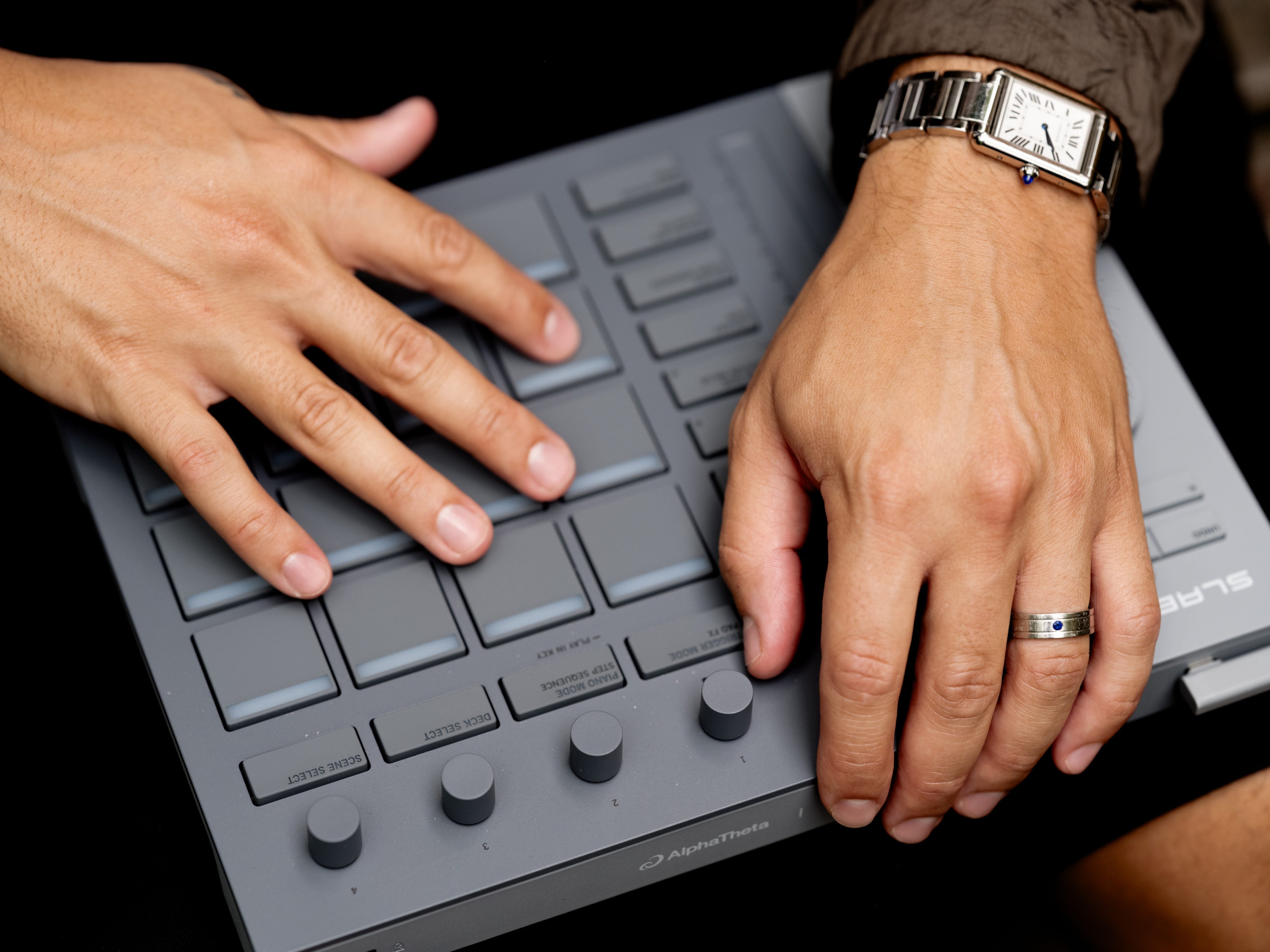
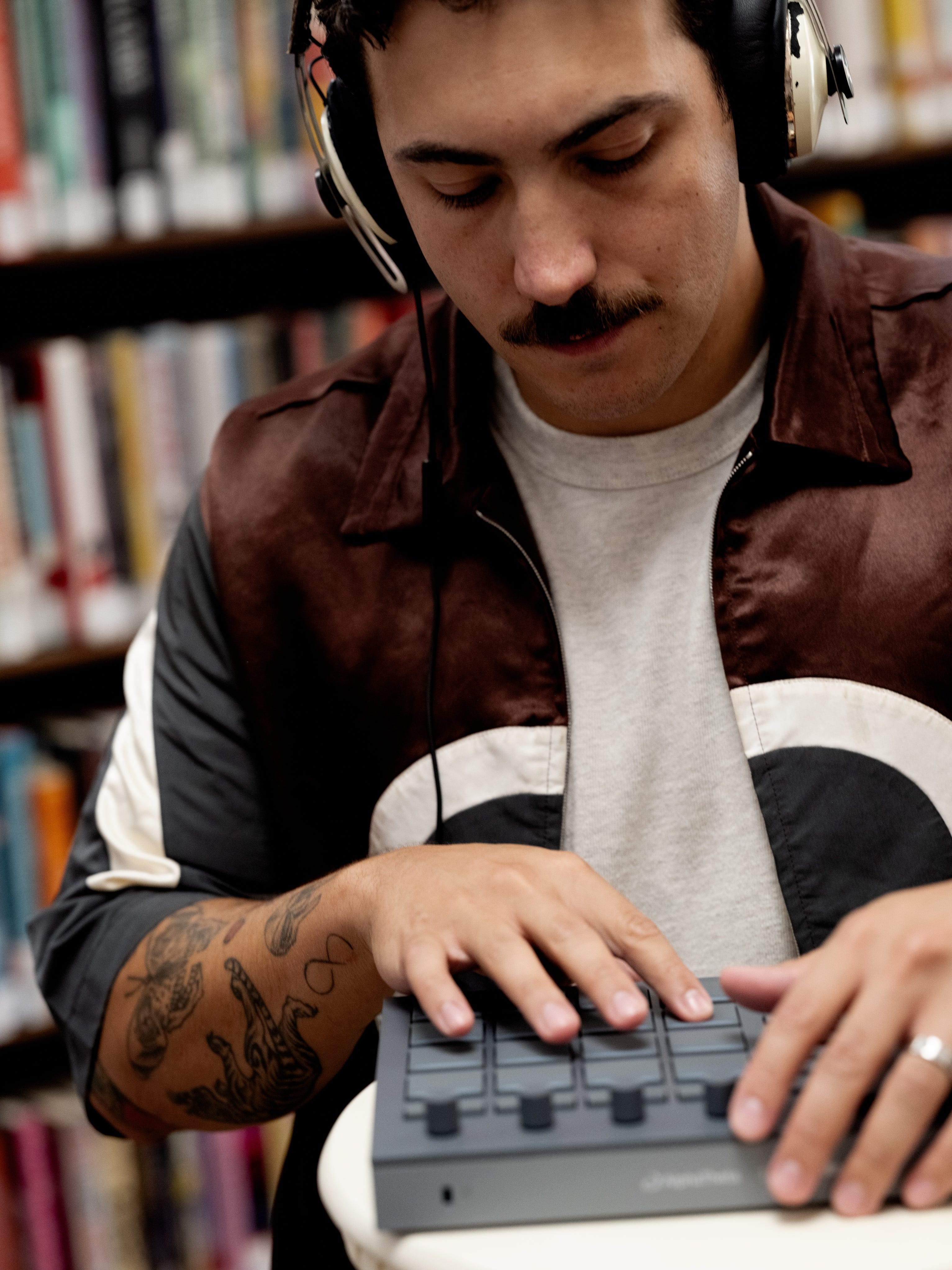
Every legendary producer has their own machine. For J Dilla, it was the MPC 3000. For you, it’s Serato SLAB. Why did you choose the SLAB?
I like the SLAB because I’m a big fan of aesthetics. Beat machines have been having a little bit of a resurgence recently.
I used to use Native Instrumentals Maschine, which I thought was a really nice tool. Then I saw that Serato started making a product called the SLAB, and I use Serato Sample to make my beat chops every day.
So I figured, why not use something that works directly with the software I already have?
Plus, I love the way it looks. It’s simple enough to figure out. You don’t need a tutorial on how to use it. I’ve been loving it so far.
What got me into drum machines was a video I saw of Kendrick in the studio with his producer, recreating one of the beats from “good kid, m.A.A.d city.” I saw him using the beat pad. At the time I was 17, probably had a little too much time on my hands, and figured I needed a new hobby. I fell in love with it ever since.
You’ve worked with artists ranging from MAVI and LIFEOFTHOM to Lexa Gates, and you won a Grammy for your work on Doechii’s mixtape. You’ve become a key figure for a new generation of thoughtful hip-hop. Do you see yourself as someone helping connect and shape this scene?
Truly, I don’t see myself as anything, so that’s a tough question. Going through this experience as a producer and artist, you just get reflections from the world. Whatever people tell you, after a while you start saying, “Oh, maybe that’s me.”
But I just see myself as someone who’s really consistent with making music and who loves music. I think after a while, the people who love music will gravitate toward each other. I’d like to think that’s what’s happening now, but who really knows?
I like being early on artists that I think are special and talented.
Truthfully, me finding artists early now comes down to just being online a good amount. I’m always on YouTube. My Instagram algorithm gives me a lot of Reels from up-and-coming artists, rappers and singers. Whenever I hear someone new and really like their sound, I’ll message them directly and say, “Hey, love this. Would you mind if I sent you some beats? I have some stuff that I think would be great for you.”
A lot of it comes from scouring the internet and finding people, and then advocating for myself as a producer and reaching out to them. Just building genuinely nice connections with people goes a long way.
I’ll also be at a show here or there that has ten people performing. Maybe I’ll love three of the artists, and I’ll reach out to them after the show or go say what’s up after they get offstage. Stuff like that goes a long way.
You built a business model that allows you to stay independent. Are type beats still a focus for you and how you make money?
The Doechii song came together because she found me on YouTube making a type beat. For me, that’s a direct signal from the universe saying, “Hey, keep doing this because good things are happening.”
I have no plans on stopping. It’s still a good chunk of my income, but more than that, it keeps me consistent. For the past six or seven years, I’ve been releasing every other day without missing any days.
YouTube plays a big part in me making a ton of beats every month. The more artists I work with, the more unique beats I have to send out. Right now, it works perfectly into my schedule.
I love doing type beats because it feels like I’m building a community there. It’s people who love music, whether they’re producers commenting a lot or artists saying, “Hey, I just made a 12-song EP using all of your beats.” That stuff is so cool to me. It’s accessible to everyone. I don’t know if I would ever stop.
As far as money is involved, I think I would keep doing it because it’s probably been the most consistent thing in my life for the past seven years.
What does your working schedule look like?
As a musician, keeping myself on almost like a nine-to-five, Monday-through-Friday schedule has worked best.
I have producer friends and artist friends who are in the studio on weekends, late at night, or only cook up after midnight.
For me, I still have friends and family living within the confines of nine-to-five, and I want to be able to make my music and be creative without burning out, while still being able to live a life.
I think you get a lot of inspiration from just living life. If you stop living life and only create, then you’re kind of in a vacuum.
What does it actually mean to be an independent producer in 2026? Has it become easier or more difficult to build a sustainable career?
I think every year it actually gets a bit harder. As far as type beats, a lot of channels don’t stay popular for more than two or three years from what I’ve seen.
For me to still have people tuning into every beat and purchasing beats, I think it’s really helped me keep pushing what I can create. Every year I have to get a little more experimental. I started out making Frank Ocean type beats, and I think if I was still making Frank Ocean beats, even though he hasn’t dropped music in six or seven years, I don’t think it would work as well.
Pushing the envelope is really important in music, and YouTube has definitely helped me with that. Thankfully, in terms of people buying beats, things have been pretty consistent for about the past six years.
There’s a lot of talk about the state of hip-hop right now. How do you see it?
I think there’s so much great hip-hop made every single year. It’s really just up to the listener to find it and whether people want to take the time to find it. Maybe people have less of an attention span or less of a will to find good music year by year. I think that could be true.
But I think hip-hop is in a fine place. I hope people keep creating it. Just like any genre, it has its eras. Classic rock in the ’70s sounds completely different from hair metal in the ’80s or punk in the ’90s.
Rap and hip-hop are generally newer genres and are still going through transformation. We’ll see. I really like how certain artists are pushing sounds and blending the elements of hip-hop that I love with newer elements and different genres.
I really love what guys like Smino are doing, blending hip-hop and R&B, singing and rapping, and using instrumentals that are just so far out. Smino’s artistry mixed with a guy like Monte Booker, who makes hip-hop but also does stuff that sounds like alternative music, has so many different genres in it. I love that.
Who do you think deserves a bigger platform right now?
There’s this dude called Q THA HERO who I think is severely underrated. He’s doing his thing and releasing a lot of really good music. He kind of falls into that jazz-rap bag, but he’s very brash-sounding. He says whatever the fuck he wants, and I love it.
I also think my brother LIFEOFTHOM is doing really good things in rap music. We spoke about guys like Smino, who I still think are yet to reach their peak. I love guys like Jordan Ward doing that R&B/hip-hop sound.
Would you like to work more with R&B artists?
Yeah, I love R&B. Anything melodic really catches my ear.
I think people love singing. When I’ve made a beat and send it to someone and they’re singing over it and it’s catchy, I think that’s just a human quality. We love singing, humming and whistling. R&B music lends itself to that so perfectly.
Do you still have any dream collaborations?
I think everyone has Kendrick as a dream collab. At the top of my list would probably be MIKE as of right now. He’s been one of my favorite artists for the past five years. He’s one of the most special artists we have right now. Between his writing, production and overall energy, you can tell that’s someone who’s very confident in what they’re doing, and people are following suit.
I would love to work with Earl as well, in a similar vein. And guys like Smino and Jordan Ward. I think we could make some really good stuff together.
Nowadays, producers like Metro Boomin, The Alchemist, and Nicholas Craven have become central figures instead of staying in the shadows. It feels like producers are essentially becoming artists themselves. How do you view that shift?
I think producers have become tired of playing the background when, in reality, we’re usually contributing at least 40-50% to the song. Sometimes more, sometimes less, obviously. I think producer-driven albums are such a good thing for music because when I listen to a producer album, it just feels more cohesive.
Sonically, the instrumental is super important to the song, and I might be very biased by saying that. But if you can have a whole body of work that sounds like you’re living in the same world, that’s so important. It really brings the listener in because we’re in a time where, if you can create a world for your audience to live in, that is the most important thing. World-building is tops.
Is that something that pushed you to make your new album “PAELLA!”?
With “PAELLA!,” I wanted to bring people into my world and show them what I liked, what sounds I liked and what artists I actually listened to.
I could almost view this as a playlist of all my favorite artists that I currently listen to in one place. I really like “PAELLA!” because people might hear one of their favorite artists over a beat they would never hear them over again.
But in my twisted mind, they were perfect for that beat, and I could hear them doing great things on it. I don’t know how experimental it is, but in that sense, it’s definitely getting people out of their comfort zones.
Where did the name “PAELLA!” come from?
My mother is Puerto Rican, and she grew up making an amazing paella dish. I always loved that.
A lot of my thoughts on album titles and song titles also come from the aesthetics of how something is going to look on paper and whether I can build a world around a simple concept. “PAELLA!” was something I scribbled in my notes probably four or five years ago.
In my mind, it’s the perfect title for a left-field producer collaborative album because you think about the dish paella and you have all these ingredients that might not normally be seen in the same places.
You’ve got shrimp blending with chorizo, blending with certain herbs and vegetables. It all comes together to make this great amalgamation. I just thought it was conceptually perfect and aesthetically perfect. That checked all my boxes.
What are your top three paellas in New York?
That’s a great question. I really like the paella at Boqueria.
Truthfully, I don’t order it a lot. My mom makes it so well. I’m like that with a lot of food. With Puerto Rican and Italian food specifically, I don’t really want to go out of my way for it because I have family making some really good shit.
Recently was the first time I ever used my mom’s recipe to make it. She makes it a lot better, but for the first time, mine came out pretty well. I give it a seven out of ten.

How much did you take the reins creatively when making “PAELLA!”?
I have no problem taking the reins and asking people what I expect from them and tailoring all of that.
I made this album because it’s all songs I wished existed. I have no problem being a little bossy and a little annoying, asking people to rewrite a verse or saying, “Hey, do you mind if I write a hook for you? I think it would sound better in your voice, but this is how I’m hearing it.”
Orchestrating all of this makes me so happy because, in my mind, there are no disappointing parts on the album.
Was there a song that took the longest to make or rewrite?
There’s one called “Gang Samba” with Q THA HERO and my homie Big Luke.
That one took about four iterations. It’s crazy because I love both of these artists so much, but certain aspects of their performances and the beats I was sending them just didn’t meld in the way I felt they should have.
But the end result was really cool. It’s two dudes rapping their asses off, saying whatever they want over a bossa nova kind of beat, which you don’t really hear a lot.
Your album has a wide range of collaborators. Did anyone surprise you?
I would like to say everyone surprised me because the performances were great, but no one really surprised me. I knew I was handpicking people who are professionals. They really do this.
If there was someone I was a little less familiar with, it was Nina Taylor. She’s a singer featured on the track “Losing Time.”
Before I started scouting for the album, I was unfamiliar with her. She had found one of my beats on YouTube, reached out to me and sent me a demo.
I took a listen and was like, “Holy shit, her voice is incredible.”
I went to check her stuff and she was super, super underrated. So maybe that’s who I was most impressed with.
What did it take to clear the samples for “PAELLA”=?”
On “PAELLA!”, because this is the first release with label backing, there were no samples uncleared.
How I’ve gone about circumventing this over the past couple of years is that I’m really lucky to have a lot of sample makers and producers who make incredible stuff. Stuff that sounds like it’s from records.
I used a lot of that on the album and flipped a lot of it. I also use services like Tracklib and Splice, where it’s either royalty-free or you can clear it with your membership. There are many ways to avoid being sued for not clearing your stuff.
What do you think about using AI for samples?
I’ve thought about the prospect of that. I know AI can make a really good rendition of a ’70s Japanese jazz track. You listen to it without really paying attention and it sounds like a real song. It’s three minutes, has different sections, a ton of sample availability.
But for me, the thought of any AI usage ever getting back to me scares me so much. I also like operating within certain confines. If my confines are, “Okay, I’m only working with samples that I know I can clear or royalty-free stuff,” I want to get the best possible result from that.
With AI, I wouldn’t feel happy about doing it like that because it feels like a shortcut. It feels kind of cheap and nasty, in my opinion. But to each their own.
Who’s to say where AI will be in five years and what the general public’s opinion on it will be?
Did you use a lot of live instrumentation on the album?
Definitely. Going back to the sample makers that I collaborate with frequently, you have guys like Max He, who played a live piano solo at the end of the intro track. I hit him up in post-production specifically for that because I knew he would come up with something incredible.
You have guys like Frollen Music Library out of Australia, who I became friendly with. They have samples with live instrumentation that I flipped on the album.
The whole album, up and down, is live instrumentation that I’ve essentially chopped, rearranged or flipped in a way that sounds really cool to me.
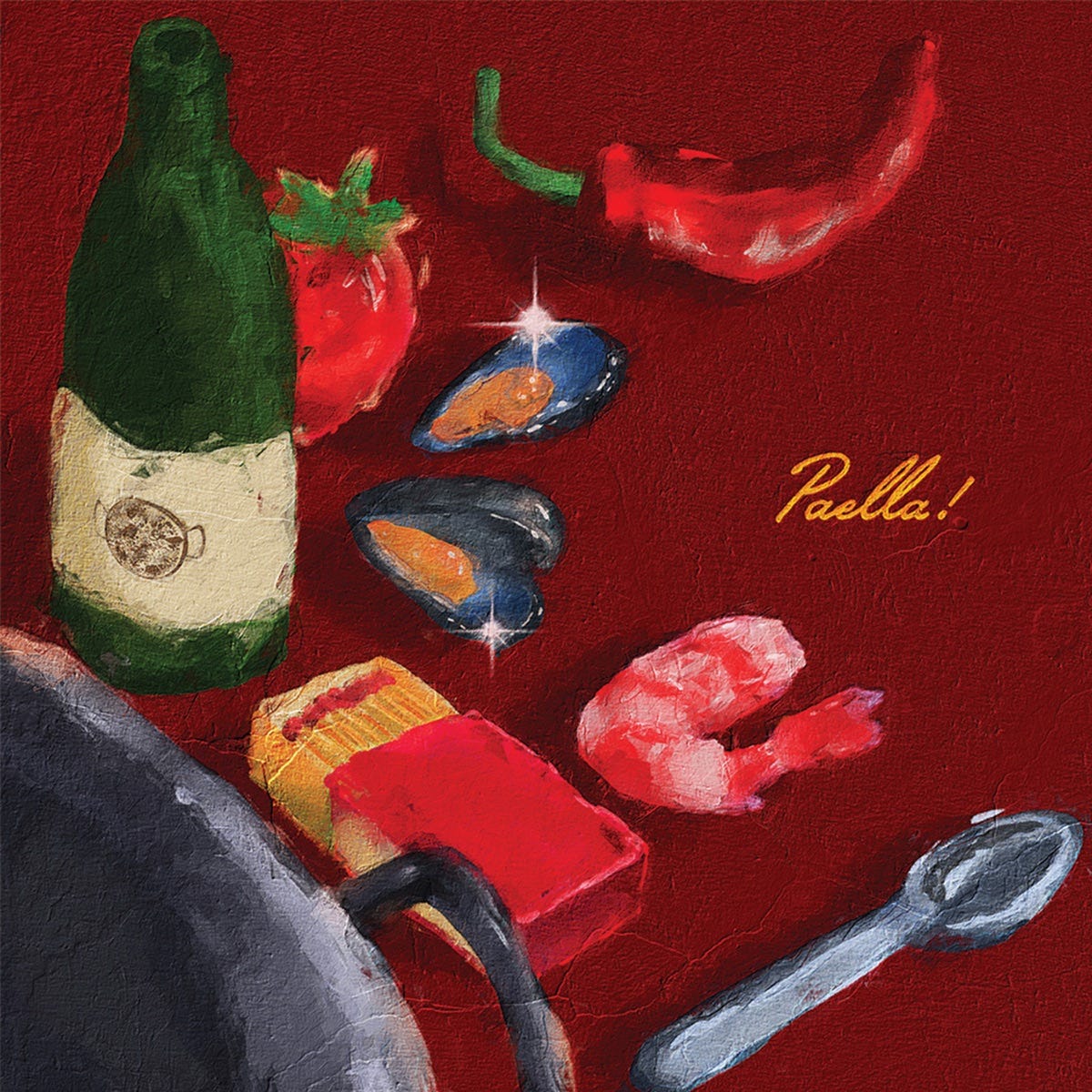
You’ve built a visual world around “PAELLA!” with artwork by Skelly. Why was it important to build such a strong visual identity around the project?
When I was working with Skelly, I showed him some of their artwork as well as a few other directions. I was like, “This is what we want.” We sat on it for about a week, brainstormed, and then we came together with the end result, which was the “PAELLA!” cover. The artwork might be my favorite part of the album.
A lot of artists shoot themselves in the foot by phoning in their artwork. If you think of music as a present, package or gift, the branding and presentation are so important. It’s the difference between your artwork catching someone’s eye, them clicking on it and finding their new favorite artist, or not.
Some of my favorite albums of all time have incredible artwork. To Pimp a Butterfly, for example. That artwork stops you in your tracks. You’re like, “What does this sound like?” Same with an artist like MF DOOM and the whole world he built around being a supervillain.
When you see artwork that someone was thoughtful about, it makes you want to dig deeper. That’s the mindset I took.
The artwork also makes the project feel more like fine art or a luxury experience. Was that intentional?
I don’t know if I was conscious of it during the process, but I did want it to feel like a luxury experience. There are so many quick, fast, cheap options in the world today that we’re missing that nice luxury feel. Everything is, “Here, take this, we’ll give you more later.” It’s quick, it’s easy. I wanted this to really be something that people could sink their teeth into.
Going back to the inspiration for the album, I wanted to touch on Action Bronson and all of his hand-painted album covers.His aesthetic is something I’ve really tried to emulate and something I’m a real fan of. He was definitely a huge inspiration for the hand-painted “PAELLA!” cover.
Those cover artworks usually look beautiful on vinyl records, where people can showcase them almost like pieces of art in their homes. Do you plan on releasing “PAELLA!” on vinyl?
Yes, the vinyl is definitely coming out. I’m really happy you said that about showcasing it in people’s houses because that’s the feeling I wanted.
I want every album cover I make to be something that could be standalone artwork. I wanted this cover to be something where you don’t even have to listen to the music. You could just have it on the wall as artwork. I think that’s a really cool idea.
What was the biggest challenge in bringing “PAELLA!” to life?
Oh my God. Trying to get 15 or so people on the same page as far as releases, sending in verses at the right time, redoing verses, listening to mixes and making sure everything’s okay. You really have to be on top of your game organization-wise because I could see an album like this taking so many years to pull together.
Luckily, I really cared about it, and I was on people’s asses and on my own self to keep going because it’s such a fucking endeavor. There are so many moving parts. I think it was worth it, and I hope the listeners think it’s worth it too. I was working on this album for about two years, maybe a little less.
There have been a lot of iterations of “PAELLA!,” but I think the one you guys are getting is the best one.
Writer: Ivan Dzhelomanov
Photographer: Christopher Currence
Stylist: Lester Fernandez